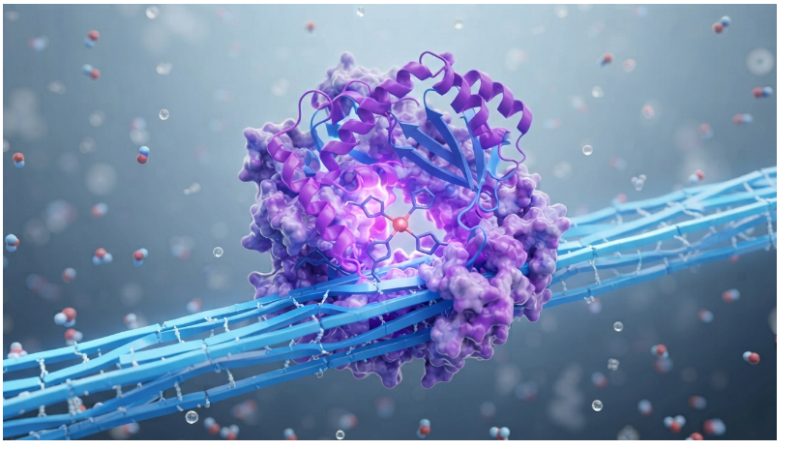
What if cellulose could gain entirely new functions without harsh chemical treatment? Lytic polysaccharide monooxygenases (LPMOs) selectively activate accessible cellulose surfaces, generating reactive anchoring points for the controlled attachment of molecules, polymers, enzymes and other functional components. This enzymatic surface-functionalisation strategy could transform renewable cellulose into tailored materials for advanced filtration, composites, biosensors, immobilised biocatalysts and beyond, using mild and sustainable conditions.
Background
Cellulose is abundant, renewable and biodegradable, making it an attractive platform for next-generation materials. However, its native surface chemistry offers only limited options for the selective attachment of functional molecules, required for advanced materials. Conventional modification methods often rely on harsh reagents, energy-intensive processing, can compromise material integrity, and result in additional waste. Hence, mild and controllable methods that activate accessible cellulose surfaces to introduce new functionality while preserving the intrinsic advantages of cellulose are needed.
Technology
LPMOs selectively oxidize accessible regions of cellulose, introducing reactive anchoring points on cellulose surfaces. By selecting suitable LPMOs and tailoring reaction conditions to the respective feedstock, we can control the extent and type of surface activation, enabling subsequent attachment of molecules, polymers, enzymes or other functional components. This provides a versatile platform for engineering cellulose surfaces under mild conditions, preserving the underlying bulk structure.
Offer
We invite industrial partners to co-develop a tailored LPMO-based cellulose surface modification for their specific materials and applications. We provide expertise in enzyme selection, production, characterisation and biocatalytic reaction development, while partners contribute relevant feedstocks, application requirements, material-performance criteria and application-specific testing. Together, we can evaluate the feasibility and benefits of an LPMO-enabled alternative to conventional chemical functionalisation, focusing on functional performance, material integrity and process sustainability.
Share your cellulose feedstock and the functionality you want to introduce. We will develop a tailored project concept for your application. We are happy to discuss your requirements under an NDA. Project-specific IP can be fully transferred to the company partner.
Experts:
Ass.Prof. Dr. Daniel KracherDevelopment status:
TRL 2-3 (concept formulated / proof-of-concept under development)Keywords:
LPMO biocatalysis, Cellulose surface oxidation, Sustainable functionalisation, Enzyme engineering, Bio-based materials, Cellulose activation, Biosensors, Surface engineering, Green Chemistry, Circular Materials, Natural, enzymatic modificationsPicture: acib, AI-generated