
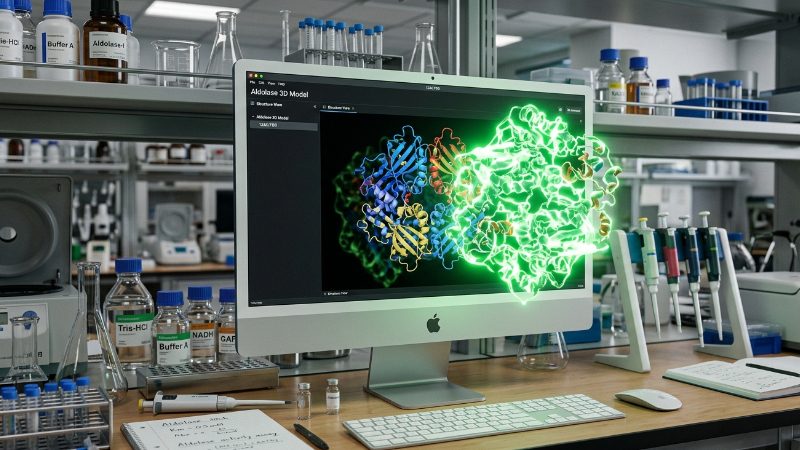
Enzymes are nature’s master chemists: they can make (or break) molecules with impressive selectivity, under mild conditions, and often with far less waste than many traditional chemical routes.
For most of industrial history, enzymes were something you discovered in nature, not something you “made to order.” If you needed a catalyst for a reaction, you searched organisms, screened thousands of candidates, then improved the best hits through rounds of mutation and testing. This has delivered many success stories, but it also created a stubborn bottleneck: when the reaction is new-to-nature, hard to screen, or needs unusually high selectivity, the discovery-and-evolution route can become slow, uncertain, and expensive.
Computers started entering enzyme engineering decades ago, first as helpful calculators: modelling structures, estimating stability, predicting which mutations might fit, or simulating substrate binding. These tools were powerful, but they mostly accelerated incremental improvement of enzymes that already existed. The big dream was always bigger: to design a catalyst from scratch for a target reaction, like an engineer designs a machine.
Over the last years, that dream became real in flashes. We learned how to “sketch” catalytic ideas in silico, how to position key residues, and how to build new protein scaffolds. But there was a repeated catch: many designed enzymes showed low initial activities, forcing developers to compensate with large screening campaigns and extensive optimization, which limits how quickly and broadly enzyme design can translate into real industrial value.
Now, a new generation of methods is closing the gap. The most exciting development is not simply “better prediction,” but a new ability to generate enzyme structures that place catalytic atoms with near-atomic precision, and to do so in a way that produces high success rates in experiments. That is the central story of “Riff-Diff” (rotamer inverted fragment finder–diffusion), which combines machine learning with atomistic modelling to scaffold catalytic arrays into entirely new proteins.
A quick historical arc: how we moved from “assist” to “design”
- Phase 1 was computational assistance i.e. using modelling to help pick mutations, improve stability, and rationalize what experiments show. Valuable, but still fundamentally dependent on natural starting points.
- Phase 2 was de novo enzyme design: trying to build catalytic function into a brand-new scaffold by placing a catalytic “idea” (the essential reactive residues) into a designed protein. This proved the concept, but the field repeatedly ran into the same industrial pain point: “It works” often meant “it works a little,” and getting to process-relevant performance typically required large experimental iteration.
- Phase 3 is where we are now: generative AI plus atomistic refinement, focused specifically on what makes enzymes so valuable …
The core problem: enzymes don’t just need an active site – they need the right active site in the right pocket
To understand why this is so hard to achieve in de novo design, it helps to zoom in on what makes an enzyme an enzyme.
An enzyme is not “just a protein that binds something.” The magic is in the precise geometry and chemical environment around the reaction’s transition state. The catalytic residues must be positioned with very tight tolerances, and the substrate must be held in a pocket that encourages the right reaction pathway rather than side reactions.
Earlier computational strategies often struggled with two connected issues.
First, even if you know which residues you want (a catalytic “array”), embedding them into a brand-new protein so that every key atom is positioned correctly is difficult. Previous attempts at grafting catalytic arrays showed activity depends on how precisely the array is reproduced in the final active site.
Second, enzymes need binding pockets that bury and orient the substrate in a way that resembles natural enzymes. Using RFdiffusion’s substrate potential can reduce clashes, but it may fail to promote well-defined binding pockets – creating a trade-off between avoiding clashes and achieving strong substrate interactions.
Riff-Diff (rotamer inverted fragment finder–diffusion) is essentially a set of innovations aimed at solving those two pain points at once: high-precision catalytic placement plus realistic binding pockets.
How Riff-Diff works
The results: “one-shot” designs that start exceptionally strong
Case 1: retro-aldolases with high activity, stability, and stereoselectivity
For retro-aldol enzymes, the authors produced 35 designs and used SAXS measurements to confirm the expected fold for 29 of them, while CD and gel filtration confirmed all designs expressed as soluble, α-helical monomers.
That alone is a practical step forward: “made it and it folded” is not a given in de novo protein design.
Even more striking is catalytic performance. The top designs (RAD35 and RAD29) achieved kcat values around 3 × 10⁻² s⁻¹ and an estimated ~5 × 10⁶-fold rate acceleration over the uncatalysed reaction. The authors emphasized that these enzymes were orders of magnitude faster than previous computationally designed retro-aldolases.
The designs also show strong stability and selectivity signatures. CD melting curves indicated high thermodynamic stability up to 95 °C for most designs, and two designs achieved ~1,000 turnovers, with one showing 99% enantiomeric excess.
Finally, the paper reports that high-resolution structures of multiple designs reveal near-atomic active site precision – exactly the kind of evidence that turns “it worked” into “we understand why it worked,” which is what industry needs if it wants predictable design.
Case 2: Morita–Baylis–Hillmanases with unusually high “hit rates”
Why this is a big deal right now, not “someday”
Industrial biotechnology is entering a period where competitiveness increasingly depends on speed: speed to prototype, speed to a robust catalyst, speed to a cleaner route, speed to scale. What this new generation of computational enzyme design offers is not merely a better tool for scientists – it is a shift in project feasibility.
When “find a biocatalyst” becomes “design a compact set of plausible catalysts with high hit rate,” more companies can consider biocatalysis for steps they previously ruled out. And when catalysts start closer to performance targets, the remaining optimization becomes more focused, more predictable, and more economical.
That is the real significance of reaching “one-shot” capability: it changes what industrial teams can rationally attempt within standard R&D timelines.
While Riff-Diff’s message is not that directed evolution will disappear in the future, but that it enables a future where the starting point is far closer to what industry needs – sometimes even comparable to variants that previously required intensive in vitro evolution.