Did you know that half the molecule is often lost before the process even starts? Bulky chiral acids should not have to start as racemates … Engineered AMDase variants can convert selected disubstituted malonic acids into optically enriched α-chiral butanoic and pentanoic acid derivatives under mild, cofactor-free conditions – opening new route options for high-value chiral building blocks.
Background
Optically pure α-chiral carboxylic acids are important structural motifs in pharmaceuticals, agrochemicals, fine chemicals and specialty building blocks. While many methods exist for α-chiral propionic acid derivatives, access to sterically more demanding α-substituted butanoic and pentanoic acids remains more challenging.
Chemical synthesis routes can involve chiral auxiliaries, stoichiometric stereodirecting agents, racemate formation followed by separation, or multi-step route development. This can reduce overall yield, increase process complexity and make early route scouting costly.
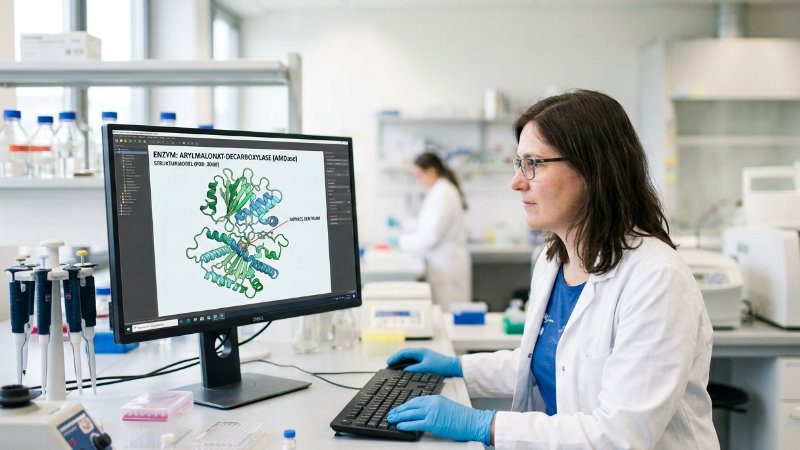
Arylmalonate decarboxylase (AMDase) is a cofactor-free enzyme that stereoselectively converts disubstituted malonic acids into optically pure chiral carboxylic acids. While wild-type AMDase is highly effective for classical α-methyl substrates, its acceptance of larger α-substituents has traditionally been limited.
Technology
acib has access to newly engineered AMDase variants with redesigned hydrophobic pockets. These variants overcome a key limitation of wild-type AMDase: poor conversion of malonic acids with larger α-substituents. The platform enables asymmetric decarboxylation of selected α-aryl and α-alkenyl malonic acids to chiral n-butanoic and n-pentanoic acid derivatives. Both R- and S-selective enzyme variants are available, allowing access to stereocomplementary products depending on the target molecule. Such engineered AMDase variants are able to convert sterically hindered substrates that were not accepted, or only poorly accepted, by wild-type AMDase. Several α-aryl butanoic acid derivatives were obtained in excellent enantiomeric purity. A pharmaceutically relevant aldo-keto reductase 1C3 inhibitor building block was produced in both enantiomeric forms with >99% ee; preparative synthesis of the S-enantiomer gave 81% isolated yield from 173 mg substrate.
Offer
acib offers to evaluate whether engineered AMDase biocatalysis provides a cleaner or more selective route to company-specific α-chiral carboxylic acid targets. Possible project work includes substrate feasibility assessment, AMDase variant screening, reaction-condition optimization, enantiomeric analysis, preparative synthesis, chemoenzymatic route scouting and further enzyme engineering for selected target structures. Any Foreground-IP can be fully transferred to the company partner.
Experts:
Prof. Dr. Robert KouristDevelopment status:
Technology Readiness Level 4 (Technology Validated in Lab)Keywords:
Chiral carboxylic acids, Biocatalysis, Arylmalonate decarboxylase, AMDase, Asymmetric decarboxylation, Chiral building blocks, API intermediates, Process chemistry, Fine chemicals, Agrochemicals, Enzyme engineering, Cofactor-free catalysis
Picture: acib