Can metabolism be switched off? How interchangeable are biological processes really?

AUTHORS

Miriam Kuzman, Lisa Sanvito, Bernd M. Mitic, Ozge Ata, Diethard Mattanovich

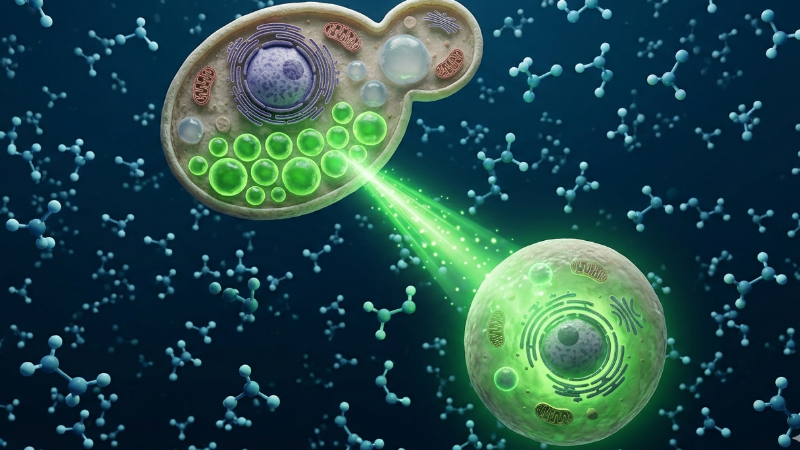
Modern biotechnology offers exciting possibilities: to put it simply, researchers draw on a vast toolkit of biological processes, extracting them from one cell and reintroducing them into their target organism. But how simple is that really? A recent paper by acib and BOKU in Vienna takes a closer look at such a process.

From bacteria to yeast – is that really possible?

All living cells need metabolic pathways to grow. These pathways consist of many small reactions that work together like cogs in a wheel. In the case of yeasts such as Komagataella phaffii, there is a natural way to use methanol as an energy source – the so-called XuMP cycle.
However, this pathway is not particularly efficient: it consumes a comparatively large amount of energy (ATP). Bacteria, on the other hand, often have a different pathway, the RuMP cycle, which requires less energy.
The researchers’ idea was therefore quite bold: why not simply incorporate the more efficient bacterial metabolic pathway into the yeast?

What exactly was done?

In the project described, this is exactly what was attempted: the yeast’s natural metabolic pathway was switched off, and the bacterial RuMP cycle was incorporated instead. The yeast then had to cope entirely with this new ‘foreign’ metabolism – and indeed: the new yeast was able to grow – using only methanol as an energy and carbon source. It was slow at first, but through optimisation and evolution in the laboratory, it improved significantly.

How easy is it really to swap metabolic pathways?

At first glance, the whole thing sounds simpler than it is. In reality, several conditions are required:

1. The right enzymes

A metabolic pathway only works if all the necessary enzymes are present. These must be produced correctly, end up in the right cellular compartment and also work together.

1. The right environment within the cell

Furthermore, cells are not empty vessels. They have their own metabolic networks and delicate balances (e.g. energy balance). This means that a ‘foreign’ pathway must fit into this network without disrupting everything.

3. Energy and material balance must be right

The new pathway must supply sufficient energy and must not accumulate toxic intermediates. Methanol is particularly problematic here, as intermediates such as formaldehyde can be toxic.

4. Fine-tuning and evolution

Even if a new metabolic pathway works in principle, it is rarely optimal. That is why adaptive laboratory evolution (ALE) – a kind of ‘controlled evolution’ – was used in the paper to adapt the cell. Metabolic pathways are therefore interchangeable in principle, but only with a great deal of fine-tuning.

Why do this at all?

The benefits are enormous: methanol is an attractive raw material because it is cheap, readily available and can even be produced from CO₂, making processes less dependent on sugar or fossil raw materials. By modifying metabolic pathways, cells can produce more of a given product whilst consuming less energy, and can also be made to utilise new substrates, which would be entirely in line with the principles of a circular economy. The design of new metabolic pathways thus opens up entirely new possibilities for new medicines, new materials or even sustainable chemicals. The applications aim to create more climate-friendly production methods.
Our conclusion: You can build a bacterial motor into a yeast cell – but it only runs properly when the whole system is tailored to it.
Picture by acib