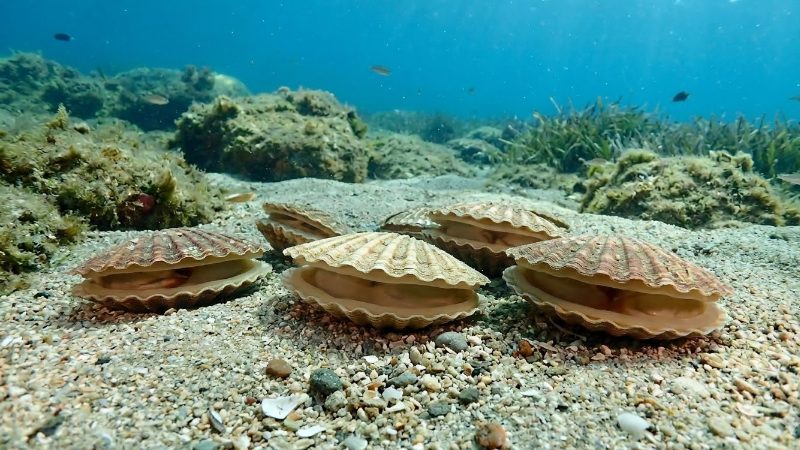
Scallop cell resources for safer, season-independent seafood: we offer establishing robust primary cultures from Pecten jacobaeus and defining species-fit media and supplements that support controlled growth and future line development.
Background
Marine invertebrates are underrepresented in cellular agriculture, despite strong nutritional, commercial, and environmental drivers. Scallop dredge fisheries damage seabed biodiversity, wild stocks vary seasonally and can accumulate biotoxins, heavy metals and microplastics, and – uniquely – no relevant farming activities are published for the Mediterranean scallop P. jacobaeus. This combination makes it a compelling model for cultivated seafood and motivates a controlled, year-round production approach.
Technology
In collaboration with Aquarium Pula, we will establish and characterize two primary cell cultures – adductor muscle and female scallop gonads – evaluate cell morphology and proliferation under temperature, pH, and salinity conditions close to the natural ones, and quantify the impact of species-informed supplements. The supplements under test include sterile-filtered hemolymph from young and maturing scallops and phytoplankton extracts; media will be benchmarked in sterilized Adriatic seawater and in commercial growth medium (L-15). In parallel, an aquarium-tank growth monitoring study provides comparative insight to inform media design and a sustainable cell/tissue sourcing concept. Whole-genome sequencing with draft annotation will establish a foundational omics resource for future line development and quality control. Ethical sourcing uses non-invasive biopsy and established hemolymph protocols wherever feasible; Aquarium Pula contributes husbandry expertise and certified animal-care standards. The same primary-culture, media-optimization, and omics workflow can be applied to additional mollusc species such as mussel, oyster, and clam.
Offer
We can tailor the collaboration to your needs – from a rapid feasibility check to staged development and transfer – with deliverables, timelines, and scope defined to your requirements.
Work proceeds under NDA; project-specific results, cell lines and associated IP can be fully transferred to you as our partner.
Experts:
DI Viktorija Vidimce-RisteskiDr. Gerhard Thallinger
Prof. Harald Pichler