
Johanna Bacher, Leo A. Jakob, Tomas Mesurado, Narges Lali, Alexander Zollner, Alois Jungbauer, Patricia Pereira Aguilar, Viktoria Mayer, Florian Steiner
- One study shows how highly pure, infectious measles viruses can be produced efficiently.
- The second paper investigates how host cell DNA and chromatin distort the analysis of VLPs – and why this is an underestimated issue in research and manufacturing.
Taken together, they paint a picture of how important it is to control impurities at every level – from research to industrial manufacturing.
The challenge: viruses & VLPs are sensitive – and their impurities are tricky
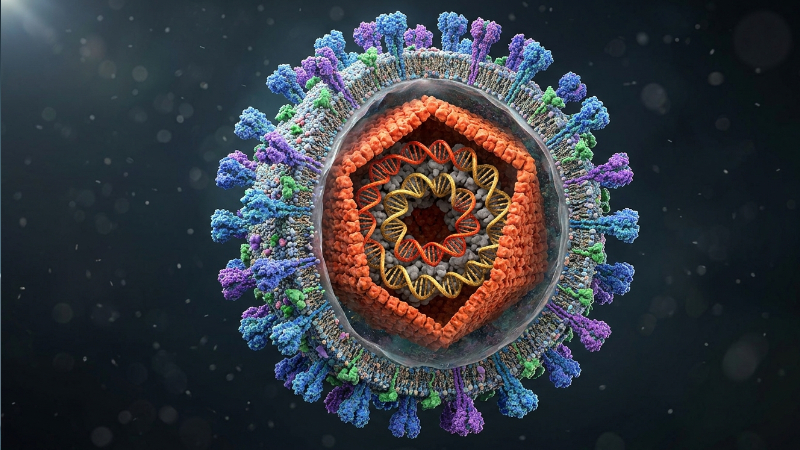
Modern biomedical applications use viruses and virus-like particles in many ways: as vaccines, as vectors for gene therapy, or even as oncolytic viruses that selectively destroy tumor cells. However, both viruses and VLPs are sensitive bionanoparticles whose function depends strongly on how clean they are and how well they are characterized.
Both publications point out, however, that DNA, especially in the form ofchromatin, is among the most critical impurities. They resemble viruses/VLPs in size, shape, and charge – and are therefore easily co-purified. This can lead to false analytical values because VLPs and chromatin elute in a similar size range; yields may also be calculated incorrectly because purity is insufficient. Without thorough removal of these impurities, even the best analytics are only reliable to a limited extent.
Efficient production of highly pure measles viruses
- Benzonase®, a traditional and commonly used endonuclease
- MSAN, a salt-active nuclease that remains effective even at high salt concentrations
Benefits of the findings
- Without good analytics, you don’t know what the product actually contains.
- Without good purification, analytics remain unreliable.
With salt-active nucleases such as MSAN and optimized analytics, new high-performance process chains are emerging – making the entire spectrum of modern viral technologies safer, faster, and more efficient.
These papers therefore lay an important foundation for future vaccines, cancer therapies, and innovative biopharmaceuticals that will directly benefit society.