
What is histamine?
Histamine is a small, biologically active molecule known as a “biogenic amine.” Your body produces it for important functions: it plays roles in immune responses (including allergic reactions), gastric acid secretion, and neurotransmission.
But histamine can also come from the outside – especially from microbes. Many bacteria can generate histamine by converting the amino acid histidine into histamine using an enzyme called histidine decarboxylase.
That microbial route is the key to understanding why histamine appears in fermented foods and drinks, and why it can sometimes spike to troublesome levels.
How does histamine get into food and beverages?
Fermented drinks: the “microbial side effect” of creating flavour
Fermentation is what gives many beloved beverages their complexity and taste. But fermentation also creates opportunities for biogenic amines – including histamine – to accumulate.
In wine, research and reviews describe biogenic amines as being produced by yeasts and especially by lactic acid bacteria, with lactic acid bacteria often highlighted as major contributors to histamine formation. A particularly important risk window discussed in the wine microbiology literature is malolactic fermentation, where lactic acid bacteria are intentionally encouraged (for acidity reduction and flavour/mouthfeel development), yet some strains can also contribute to histamine production.
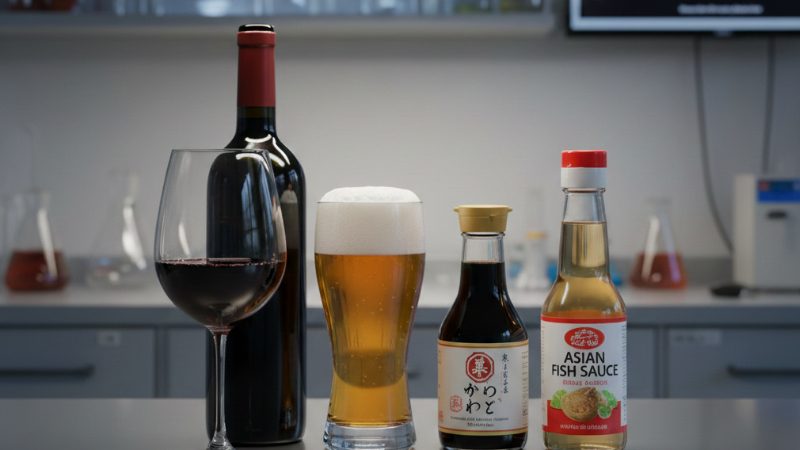
Beer, cider, perry, sake, kombucha, kefir, and basically all other fermented beverages can face similar dynamics: microbial diversity and process conditions that make a beverage interesting can also make biogenic amines harder to control.
Fish sauce and brines: the “histamine classic” and why regulators care
When is histamine actually a problem for people?
1) Acute histamine poisoning: “too much histamine at once”
2) Histamine intolerance: “histamine load exceeds your ability to break it down”
Histamine intolerance is generally described as a condition where the body’s capacity to metabolize ingested histamine is overwhelmed – often associated with reduced activity of diamine oxidase (DAO), an enzyme important for degrading histamine in the gut/extracellular space.
The symptom picture can be broad and “allergy-like,” including headaches, gastrointestinal discomfort, flushing, and other reactions, and it can vary strongly between individuals. Reviews discussing DAO deficiency emphasize that when DAO activity is insufficient, histamine can accumulate and trigger symptoms in sensitive individuals.
Histamine intolerance is not as simple as “X mg/L is always fine” for everyone. There is a wide variability in doses and interactions with other biogenic amines that can compete with histamine degradation.
For producers, however, the market implication is straightforward: even if only a fraction of consumers are sensitive, they are highly motivated, they actively search for “better tolerated” products, and they tend to become loyal customers when they find options that work for them.
Why “histamine-reduced” drinks are attractive
So why isn’t this already standard?
Because current levers tend to fall into two imperfect categories: prevention and late-stage intervention.
Prevention strategies can be very effective, but they mainly reduce formation rather than remove histamine already present. In wine, for example, published work and industry guidance emphasize fermentation management, hygiene, and careful choice of starter cultures to lower the risk of biogenic amine formation, including histamine.
Late-stage interventions exist (fining/adsorption approaches, electrodialysis-type methods, enzymatic degradation concepts, or other remediation steps), but they often carry trade-offs in sensory impact, cost, complexity, or retrofit difficulty – especially when you want something that works as a simple, scalable unit operation on real production lines.
This gap i.e. a practical, in-process removal step that preserves flavor and line speed, is exactly what is missing in today’s toolbox.
An innovative “contact-and-capture” magnetic histamine removal
Why magnetic removal is such a good fit for beverages
The “magic” here is not only that adsorption exists – adsorption is well known. The advantage is that magnetic recovery can be extremely fast and clean, which matters for beverages where producers care about line speed, clarity, and sensory integrity.
The offer highlights several practical goals that reflect real industry pain points.
- It is designed to be fast, preserving line speed.
- It aims to preserve sensory quality (flavour and mouthfeel), a key risk with many remediation techniques.
- It provides a tunable lever on histamine specs, rather than a “one shot” approach that may over-correct or under-deliver.
- It is positioned as compatible with challenging beverage conditions, as it does not rely on dissolved oxygen and produces no reactive by-products — important because those issues can break many otherwise promising solutions.
What kinds of products could benefit?
How development would work in practice: short pilots, real liquids, fast learning
The bigger vision: a new category of “better tolerated” fermented drinks
Let’s work together, in making this vision a reality! Here you will find our related tech offer.